Twentyone Hotel Kifisia: The Chateau Marmont Feeling
Field Notes from a Hotel Brand Director: When the Place Is the Message
I almost didn’t book Twentyone.
I went on the website and couldn’t feel it. No clear message. No story. No promise. And in a world where every boutique hotel sells you a narrative before you even arrive, this felt like a miss.
Then I ended up in Kifisia, booked it anyway — and within minutes of checking in I understood something rare:
This hotel doesn’t need the website to communicate. The hotel is the message.
There’s something both good and bad in that (I’ll get to it). But from a hotel brand director point of view, this was close to a dream. It’s the kind of place that makes you think: this is what boutique hospitality was meant to feel like.
I’ll go back again and again. It’s the closest thing to a “second home” I’ve ever felt in Athens.
1) You don’t check into a hotel. You check into a restaurant.
The first branding decision hits you immediately:
You check in through the restaurant.
No lobby theater. No “boutique hotel” performance. No staff choreography behind three screens while you wait under a scent diffuser and a playlist trying too hard.
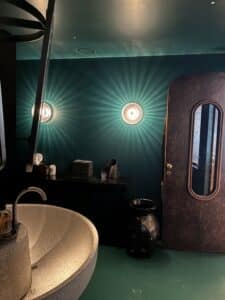
Instead: a simple desk, and behind it an entrance that feels like a private doorway — a mid-century / art-deco moment that instantly shifts you into house energy. You’re not being processed; you’re being received.
That move alone does something many hotels spend a fortune trying to manufacture:
It gives the guest the feeling of belonging.
2) The brand begins before you enter: the street does half the storytelling
Here’s where the owners did something very few hospitality projects achieve:
the brand extends beyond the property line.
The street in front of the restaurant carries an upscale, composed feeling — not because of the cars parked outside, but because of the urban texture:
the cobblestone sidewalk
the iron details and boundaries
the slightly secretive walls protecting the courtyard
the tall chestnut trees, mixed with citrus
the mid-century quality of the surrounding buildings
This is what I call exterior brand equity — the contextual aura that most hotels can’t manufacture. It’s urbanistic. It’s environmental. It’s a kind of luck… but it’s also taste, selection, and restraint.
And it changes everything: by the time you step inside, you already believe.
3) The courtyard: understated South-of-Europe, with a precise reference point
Then you enter the courtyard and the mood locks in.
Umbrellas. Greenery. iron chairs. plants everywhere. Large bay glass windows in a deliberate shade of green. A feeling that’s sunny, elegant, and quietly cinematic — South of Europe without trying to prove it.
If you know the Chateau Marmont in LA, you’ll understand the association immediately: not because it copies it, but because it touches the same code — privacy, ease, a little mystery, and effortless cool.
And there’s a detail that proves the owners understand hospitality psychology:
the pool.
It’s not there to impress. Not there to swim. It’s there to introduce the water element — the Greek ritual of sitting near water, the suggestion of a cocktail, a lounge chair, a pause. It’s proportioned right. Tiled right. Positioned right.
It reads less like an amenity and more like a scene.
And yes — I had a Somewhere moment (Sofia Coppola). That same quiet luxury: nothing screams, but everything communicates.
They didn’t just design for summer. They designed for Athens winter.
The bay windows keep the space “outdoor” even when you’re inside. Then they layer warmth on top:
bulb lighting (the kind that feels human, not corporate)
candles everywhere
a subtle Scandinavian-like coziness inside a Greek setting
Most places either go full Mediterranean brightness (cold at night) or full “cozy concept” (dim and heavy). Here it’s balanced. And it’s one of the reasons you relax so quickly.
5) The restaurant is not separate from the rooms — it creates the rooms
I realized something while I was trying to describe the hotel:
I kept talking about the restaurant.
The bar. The corners. The long sofa line. The breakfast room. The way the layout creates intimacy without being cramped.
And that’s the point.
The restaurant is not an “add-on.” It is the atmosphere engine of the entire hotel.
It’s what makes you sleep upstairs as if you were in a home you designed yourself — but with an extra layer you can never achieve in a private apartment: social warmth, aesthetic continuity, a living rhythm.
If you’ve read my earlier reflection on the Royalton in New York — how great hotels stage life like a film set — you’ll recognize the same principle here, translated into a smaller, more understated language.
6) Rooms: simplicity with precision (and bathrooms that actually matter)
Upstairs, the rooms are simple — but not generic.
The furniture feels custom or at least deeply considered: mid-century discipline with a European art-deco undertone. The materials are quiet but confident. Tiles, frames, lighting — few elements, meaningful choices.
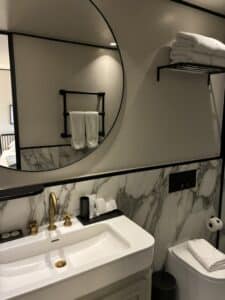
And then the bathrooms: generous, designed, and unusually well executed for a hotel this size.
Bathrooms are where small hotels often fail — either too tight, too standard, or value-engineered into sadness.
Here they complete the promise.
7) The honest truth: this is why they “don’t need” the website
Now the honest brand-director note:
Yes, the website could communicate more. It could convert better. It could carry the story and scale the awareness.
But the reason they can afford not to is simple:
They’ve built something rare: an experience that speaks louder than marketing.
It’s intimate — a small collection of rooms — and it delivers understated, refined hospitality with a coherence you don’t often find, even in far larger, more expensive properties.